RPISEC ran a capture the flag called Hack the Vote 2016 that was themed after the election. In the competition was "The Wall" challenge by itszn.
The Wall challenge clue:
The Trump campaign is running a trial of The Wall plan. They want to prove that no illegal immigrants could get past it. If that goes as planned, us here at the DNC will have a hard time swinging some votes in the southern boarder states. We need you to hack system and get past the wall. I heard they have put extra protections into place, but we think you can still do it. If you do get into America, there should be a flag somewhere in the midwest that you can have. You will be US "citizen" after all.
The challenge link was a tarball with a bunch of directories. Inside the /bin/ folder was an x64 ELF called "minetest", which is a Minecraft clone. I was pleased to see this was a video game challenge, having a fair amount of infamy for hacking online games in my past lives.
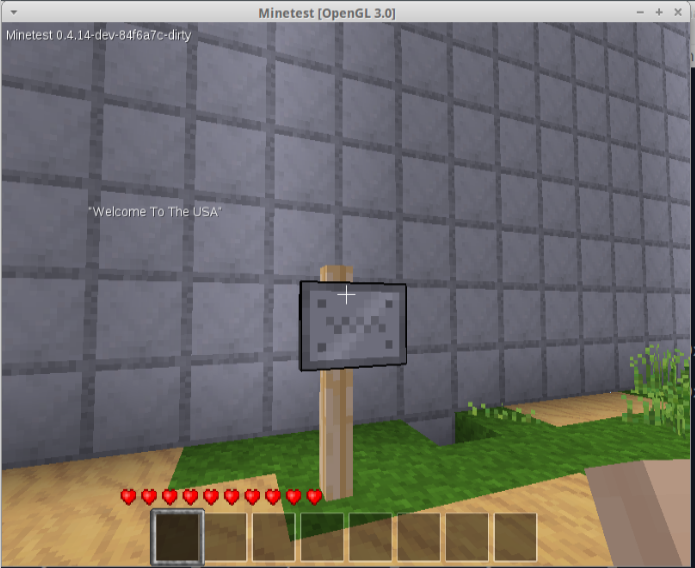
When you run the game, you log onto a server and are greeted with Trump's wall. It's yuuuge, spanning infinitely across the horizontal plane.

So the goal must be to get around this wall and into America. I tried a few naive approaches, as I just wanted to get something like a simple warp or run-through-wall type of cheat running, but alas there was an anti-cheat built into the game.

No problem, it wouldn't be the first time I've had to defeat an anti-cheat system. I started reversing a function called Client::handleCommand_CheatChallange() (sic):

I deduced this function was reading /proc/self/maps and running a SHA1 function on it. At first I was going to just overwrite this function to make it give the expected SHA1, but then I started backing up and found this function was only called when you first joined the server. So all that was needed to bypass the anti-cheat was to delay load however I planned to cheat.
Poking around the game and binary some more, I noticed there was a "fly" mode, that my client didn't have the privilege from the server for:

Well, my client still has the code for flying even if the server says I don't have the privilege. I found a function called Client::checkLocalPrivilege(). The function takes a C++ std::string of a privilege (such as fly) and returns a bool.

Yea, this guy's doing way too much work for me. Time to patch it with the following assembly:
inc eax   ; ff c0
ret       ; c3
nop       ; 90
This will make the function always return true when my client checks if I have access to a certain privilege. After logging into the server, I attached to my client with GDB and patched my new assembly into the privilege check function:

Now that I could fly, I noticed the wall also grew infinitely vertical. Fortunately, from way up high I was able to glitch through the wall.

I made it!

I wandered through the desert for 40 days and 40 night cycles.

No really, I wandered a long time. I should also mention disabling the privilege checks gives access to a speed hack, but it was a little glitchy and the server kept warping me backwards.
I was starting to get worried, when all of a sudden I saw beautiful Old Glory off in the distance.


