Showing posts with label disassembler. Show all posts

Thursday, September 8, 2016

Removing Sublime Text Nag Window

I contemplated releasing this blog post earlier, and now that everyone has moved on from Sublime Text to Atom there's really no reason not to push it out. This is posted purely for educational purposes.

Everyone who has used the free version of Sublime Text knows that when you go to save a file, it will randomly show a popup asking you to buy the software. This is known as a "nag window".


The first time I saw it, I knew it had to be cracked. Just pop open the sublime_text.exe file in IDA Pro and search for the string.


We find a match, and IDA tells us where it is cross referenced.


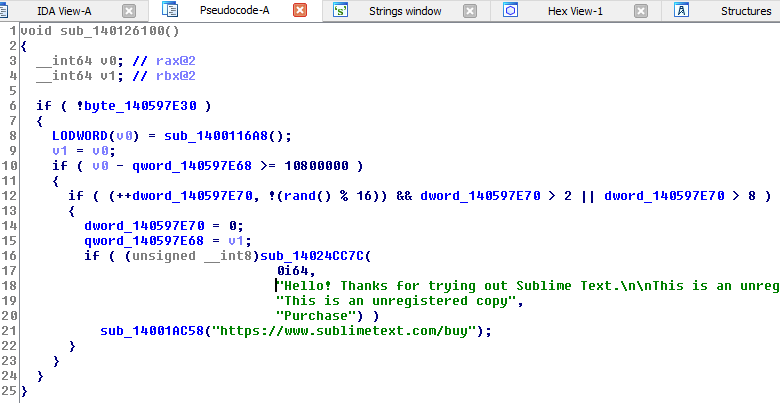
We open the function that uses these .rdata bytes and see that it checks some globals, and performs a call to rand(). If any of the checks fail it will display the popup. The function itself is only about 20 lines of pretty basic assembly but we decompile it anyway because the screenshot is cooler that way.


We open the hex view to see what the hex code for the start of the function looks like.


Next we open sublime_text.exe in Hex Workshop and search for the hex string that matches the assembly.


Finally, we patch the beginning of the function with the assembly opcode c3, which will cause the function to immediately return.
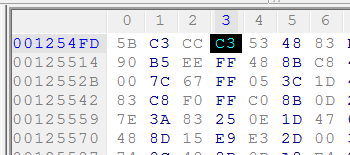


After saving, there will be no more nag window. As an exercise to the reader, try to make Sublime think you have a registered copy.

Saturday, January 10, 2015

Practical Reverse Engineering p. 36 #12

Question number 12 on page 36 of Practical Reverse Engineering is as follows:

Bruce's favorite x86/x64 disassembly library is BeaEngine by BeatriX (www.beaengine.org). Experiment with it by writing a program to disassemble a binary at its entry point.

This program is called the Burdensome Arbitrary Disassembler (BAD). You must supply the file name and address of the entry point as arguments. Parsing PE and ELF files is pretty trivial, but then it wouldn't be BAD.

#include <stdio.h>
#include <stdlib.h>
#include <stdint.h>
#include <string.h>

#define BEA_USE_STDCALL    
#include "headers/BeaEngine.h"

void *read_file(void *dest, char *file_name, long *file_size)
{
    FILE *fp;

    fp = fopen(file_name, "rb");
    fseek(fp, 0, SEEK_END);

    *file_size = ftell(fp);
    dest = malloc(*file_size);

    rewind(fp);
    fread(dest, 1, *file_size, fp);
    fclose(fp);

    return dest;
}

void disassemble(char *file_name, uint64_t offset)
{
    DISASM dsBea;
    uint16_t len = 0;
    uint8_t *pe_file = 0;
    long file_size;
 
    memset(&dsBea, 0, sizeof(DISASM));
    dsBea.Archi = 64;

    pe_file = read_file(pe_file, file_name, &file_size);

    file_size -= (long) offset;
    dsBea.EIP = (uint64_t) &*&*(pe_file + offset);
 
    while(file_size > 0)
    {
         len = Disasm(&dsBea);

         if (len == UNKNOWN_OPCODE)
             break;

         dsBea.EIP += (uint64_t) len;
         file_size -= (long) len;

         puts(dsBea.CompleteInstr);
 }

    free(pe_file);
}

int main(int argc, char *argv[])
{
    disassemble(argv[1], atoi(argv[2]));
    return 0;
}

Here is an example of disassembly:

C:\BAD\x64\Debug>bad test.exe 3312

sub rsp, 28h
call 0047BCB0h
call 0047AB50h
add rsp, 28h
ret 
...

This matches IDA's output (besides mapping address offsets):